
Quick Overview
When Make A Splash Productions needed to power 140 practical light fittings on a fully rotating fairground carousel for Disney's Zombies 5, conventional grid connection was not an option. Powerbox Pacific engineered a compact, self-contained power system based on the Victron MultiPlus-II 48/6000/100-50 GX inverter-charger and four Amptech 12.8 V 120 Ah LiFePO4 batteries, sized to deliver 6 kW of usable output while fitting within the carousel's existing steel hub framework. The solution provided up to 3.5 hours of autonomous runtime during rotation, with the ability to recharge overnight between filming days. The system ran without issue across two full weeks of production at Studio West in Glen Eden, Auckland.

The Challenge
When a large fairground carousel was purpose-built for the set of Disney's Zombies 5 at Studio West in Glen Eden, the lighting department faced a problem with no obvious solution. The carousel was designed to rotate continuously on a digger cog mechanism, which meant there was no fixed point at which a standard external power feed could connect to the 140 practical light fittings mounted on the exterior.
Mark Newnham, Practical Lighting HOD on the production, investigated two alternatives before approaching Powerbox Pacific. The first was installing ring gear to transfer power from an external AC feed across the rotation point, but the confined internal geometry of the carousel hub made this impractical and expensive to install. The second was an off-the-shelf battery storage unit from another manufacturer, but the required capacity would not fit through the metal framework of the centre hub.
The electrical load requirement was significant: up to 6 kW of draw capacity to service the full lighting rig, even though a wireless dimming sequence meant not all bulbs would operate simultaneously. The solution also had to be ready before filming commenced, with a narrow installation window once the carousel was assembled in position on set.
The Solution
Powerbox Pacific's Alistair Jeffcoat and the company's application engineer designed and installed a self-contained power system configured to meet the load and fit the available space within the carousel framework.
At the core of the system is a Victron MultiPlus-II 48/6000/100-50 GX inverter-charger. In a single wall-mounted enclosure, it combines a 6 kVA pure sinewave inverter, a 100 A battery charger, and Victron's integrated GX communication controller. Rated for 48 V DC input and 230 V AC output, the MultiPlus-II GX is built for self-contained power islands and can accept an external AC supply to top up the battery bank when one is available. The full Victron Energy range carried by Powerbox Pacific is listed on the brand page.

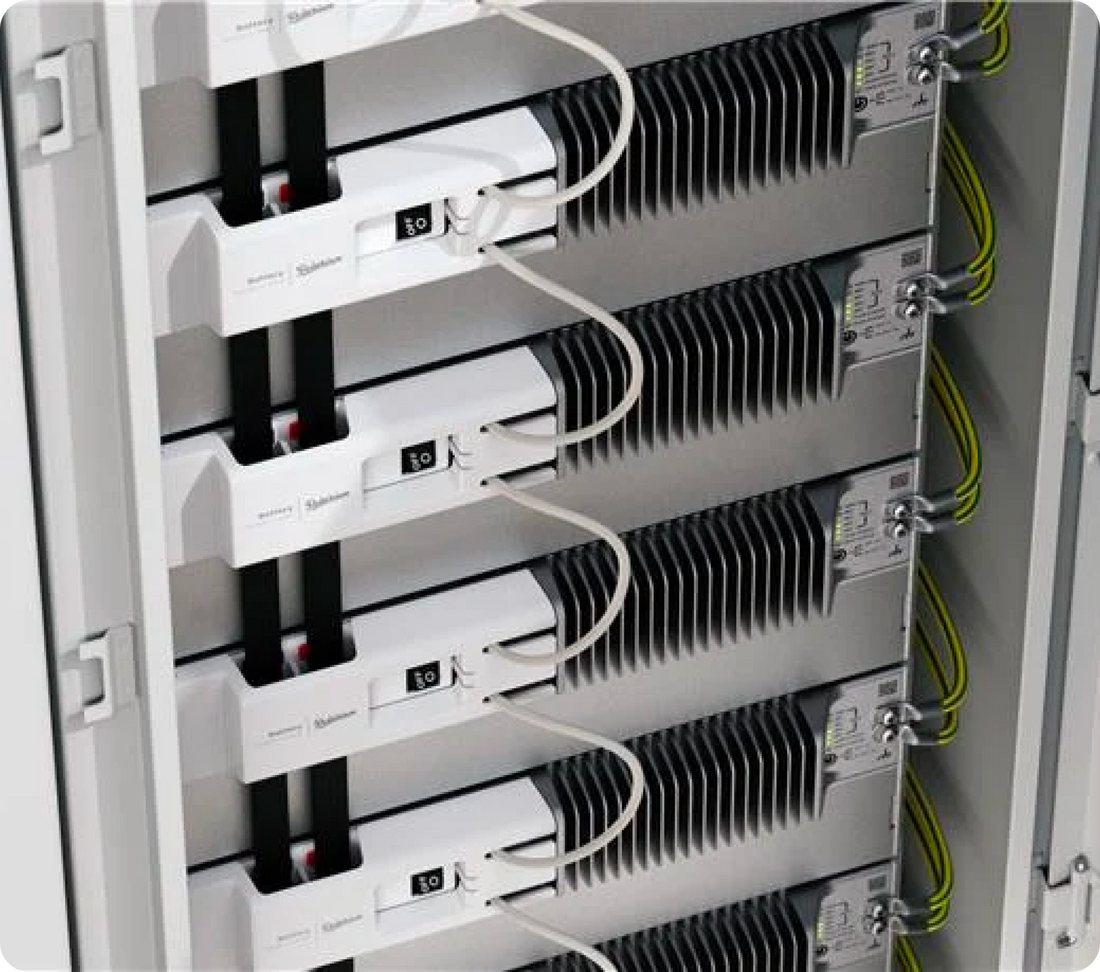
Four Amptech ATLS12-120 LiFePO4 batteries, each rated at 12.8 V and 120 Ah, were configured in series to form a 48 V, 120 Ah bank. The Amptech units are built around cylindrical LiFePO4 cells with an integrated BMS providing protection against overcharge, over-discharge, short circuit, and cell imbalance, and are rated for more than 6,000 cycles at 80% depth of discharge. A Victron BMV-712 Bluetooth battery monitor was also included, giving the lighting team a real-time view of battery state of charge during production.
The 230V AC input function on the MultiPlus-II GX provided an important operational benefit: when the carousel was stationary but still visible on camera and needed to remain powered, the system could accept a grid connection and continue running without drawing down the battery bank. This substantially extended the effective runtime across each filming day.
All hardware was fitted within the existing steel structural framework of the carousel hub, working within the spatial constraints determined by the set construction team.
The Outcome
The Powerbox Pacific system ran without incident across two full weeks of filming on the carousel set. With the battery bank charged overnight between production days, the system delivered the 6kW load capacity required for the full rotating lighting rig throughout each day's shooting schedule.
The four twin fade dimmers installed inside the hub, which controlled the exterior light fittings wirelessly from an MA Lighting desk on the production floor, operated as expected with no power interruptions during rotation.
Mark Newnham, Practical Lighting HOD, noted that Powerbox Pacific was the first supplier to respond with a workable solution, and that the installation team completed the work efficiently within the tight schedule. Consistent communication throughout the project, including the extensive documentation requirements associated with an overseas Disney production, was noted as a specific positive.

Why It Matters
This application sits well outside the conventional framing for industrial inverter-charger systems, but the underlying engineering requirements are not unusual: a defined load, a constrained installation envelope, a need for autonomous runtime, and the option to recharge from an external AC source when access allows. The Victron MultiPlus-II GX platform is well established in demanding off-grid and mobile applications, including marine, remote telco, and transport. The carousel installation at Studio West is a practical example of how the same capability applies to any situation where a rotating, mobile, or physically isolated load requires a self-contained AC power source.
For specifiers working on installations where a conventional grid feed is mechanically or practically unavailable, a properly sized inverter-charger and lithium battery combination is often a faster, more cost-effective solution than ring gear, slip rings, or running cabling to a moving structure.
To discuss inverter-charger sizing and installation for your application, contact the Powerbox Pacific team.
Frequently Asked Questions
What is the Victron MultiPlus-II GX and how does it differ from a standard inverter?
The Victron MultiPlus-II GX is an all-in-one inverter-charger with an integrated GX communication and monitoring controller. Unlike a standalone inverter, it also incorporates a battery charger and can accept an external AC input to extend runtime or top up the battery bank when a grid or generator connection is available. The GX variant adds onboard system monitoring and remote access without a separate display unit.
How long can a 48 V, 120 Ah LiFePO4 battery bank run a 6 kW load?
Four Amptech 12.8 V 120 Ah batteries wired in series produce a 48 V, 120 Ah bank with approximately 5.76 kWh of nominal energy. At 80% depth of discharge (the recommended limit for LiFePO4 to preserve cycle life), usable capacity is around 4.6 kWh. Accounting for inverter efficiency, practical runtime at or near full load is around 3 to 3.5 hours. Where the dimming sequence means not all bulbs draw simultaneously, runtime extends further. Overnight charging from a standard 230 V AC supply is sufficient to restore the bank between filming days.
Can a Victron MultiPlus-II system accept an external AC supply and battery power simultaneously?
Yes. The MultiPlus-II includes PowerAssist functionality, which allows it to supplement a limited external AC input with battery power to meet peak demand, and PowerControl, which prevents overloading the AC source by reducing charger current as needed. In the Zombies 5 installation, when the carousel was stationary and a grid feed was available, the system operated on AC input, preserving battery state for subsequent rotation periods.
Can Powerbox Pacific design and install custom inverter-charger systems for unusual applications?
Yes. Powerbox Pacific provides application engineering support for projects where off-the-shelf configurations do not directly meet the brief. This includes load analysis, battery sizing, and equipment selection from the Victron Energy range and other brands. Contact the team at sales@powerbox.co.nz or call 09 415 8320 to discuss your requirements.
About the Author
Alistair Jeffcoat, General Manager, Powerbox Pacific
Alistair Jeffcoat is General Manager of Powerbox Pacific, with extensive experience in power conversion, energy storage, and off-grid power system design across New Zealand and international markets. He works directly with customers to engineer practical solutions for applications where standard configurations do not fit, from industrial control systems to mobile and remote power installations.